Alternative grading
If the traditional points-based grading system ever irks you or just doesn’t sit right with you, you might want to consider alternative grading! I’ve been interested in trying some different kind of grading system in my classes that does not heavily penalize students for making mistakes. The process of learning is built upon a foundation of making mistakes, learning from those mistakes, and trying again later. Our typical grading systems don’t often encourage this process of learning, which leads to students cramming for high-stakes exams and then forgetting the material immediately after.
Here, I’ll share some resources and lessons from my alternative grading journey in some of my classes that might benefit you!
This is a general biology class intended for non-majors at CSU. In this class, I teach ~250 students in the Fall and ~180 in the Spring, which range from Freshman class standing all the way to Senior. I decided to remove traditional grading in this class for two main reasons:
- Remove stress from students who need this class as a gen-ed requirement
- Give students space to worry more about learning and less about grades
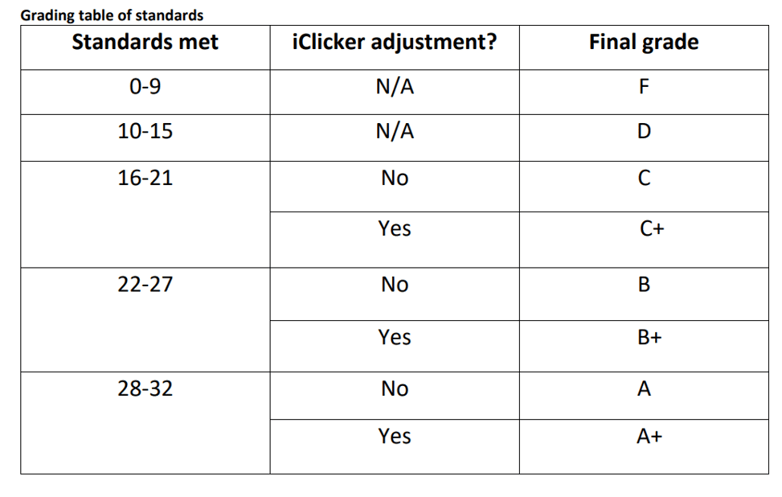
I’ve moved the grading system to be more of a threshold/standards based grading system. Below is a table of how student grades break down:
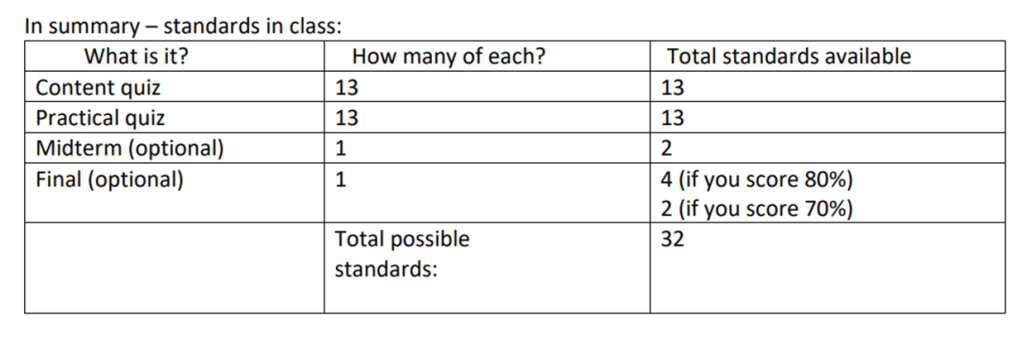
To expand, let’s think about how students earn these standards in the first place. Students earn standards by:
- Scoring an 80% or higher on a weekly content quiz
- Scoring an 80% or higher on a weekly application quiz
- Scoring an 80% or higher on the midterm exam
- Scoring a 70% or higher on the final exam
All students start at 0 standards met at the beginning of the semester and slowly build their grade up until finals week. That means they will never see their grade go down during the semester. Here’s a table describing this:
Now, what is this iClicker adjustment? In each class, we use iClicker to answer real-time questions and get practice. The students earn full credit for answering correctly and half credit for answering incorrectly. If a student has an 80% on their total iClicker credit by the end of the semester, they will earn a “+” on their letter grade (C, B, or A, only).
You might notice that students can only earn up to a B based on quiz standards. This is intentional! If a student really wants to earn an A and cares about that, they can take the midterm or the final to earn those additional standards to get them to an A. If a student taking this gen-ed class only cares to get a C, they don’t need to take the midterm or final. This is sort of a “choose your own adventure” style approach to earning your grade in the class.
The final, really important part to this setup is what I call a standard reboot week. These are pre-defined weeks during the semester (weeks 5, 10, and 15) where I open up alternative versions of each quiz up until that point in the term on Canvas. During those weeks, if a student didn’t initially earn a standard on a quiz (i.e. got a score below 80%), they can attempt the reboot version to earn the standard. Below is a picture of what students may experience:
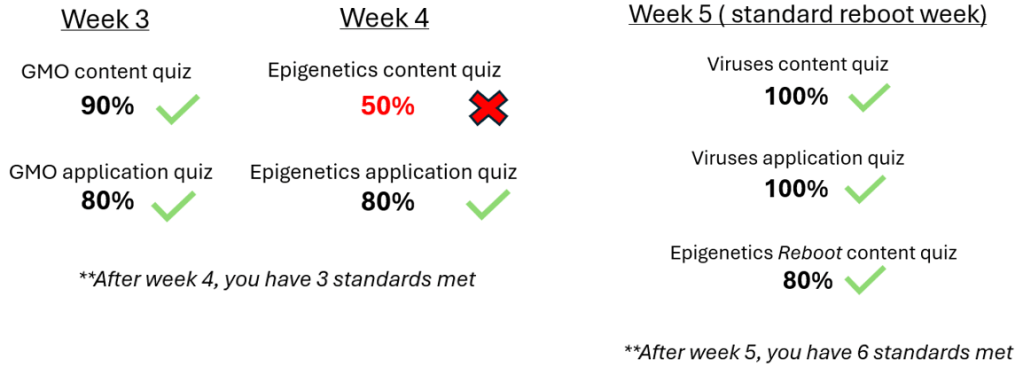
In the above example, this student didn’t earn the epigenetics content standard, but was able to earn it in the upcoming reboot week in week 5. Thus, meeting all the standards possible by the end of the first standard reboot week.
I won’t go much into the outcomes of shifting to this new setup, but can give a few:
- Attendance is ~ the same as what I had in a traditionally graded version of this class
- Avg. GPA in the class went up slightly
- DFW rates dropped DRAMATICALLY (Went from ~9% to 4% when switching to this system)
- Student morale is much higher and students express appreciation for the flexibility
- Built in flexibility and optional midterm/final lead to far less point make-up requests and grade changes
Okay, that’s it! If you want more details about how I pitch this set up to my students on day 1 of the semester and a few other points about my design, I gave a talk at the 2026 Grading Conference on this class. Below is a link to the slides: