Using social media in the classroom
Think about your field of study and where students often encounter this field in their day to day lives. For me, biology seems to come to life (pun intended) not through regular exposure to textbooks, but rather through social media. Instagram, TikTok, Facebook, Twitter, and more, all tantalize our students on the daily with topics related to what they see in school. Some of that is legit, quality information, while a lot more is inaccurate, misleading, or AI slop.
Here, I want to share with you some information and resources about how I ditched a textbook and incorporated social media in one of my classes. Specifically, this is my biology course for non-majors, which seats over 500 students every year. Since this may be the only science class they take, I needed to make it count!
This is a general biology class intended for non-majors at CSU. In this class, I teach ~250 students in the Fall and ~180 in the Spring, which range from Freshman class standing all the way to Senior. I decided to incorporate social media examples (Facebook posts, Instagram reels, TikToks, etc.) for a few reasons:
- Misinformation is everywhere online in the social media space. Students should get some training in being able to spot this!
- Social media is where many younger people get their news/information
- Many younger folks spend a lot of time on social media
- A TikTok video is usually more engaging than a textbook paragraph
As a Zillenial, I also really often find myself on social media. It’s actually quite fun to find examples of both compelling and rage-inducing science videos/posts in my feed to use in class! The nice thing about using social media in your class is that you can do this as sparingly or extensively as seems appropriate for your class goals and learning outcomes. Here’s a few tidbits about how I do this:
Start the lecture topic with a compelling “hook” of a post
Social media is literally engineered to be attention grabbing! Ever heard of “click-bait”? Intentionally making a post with crazy graphics and wild claims to get engagement? Yeah, you can take advantage of this. Say I’m starting a lecture on cancer biology. I might begin my lecture with showing something like this:
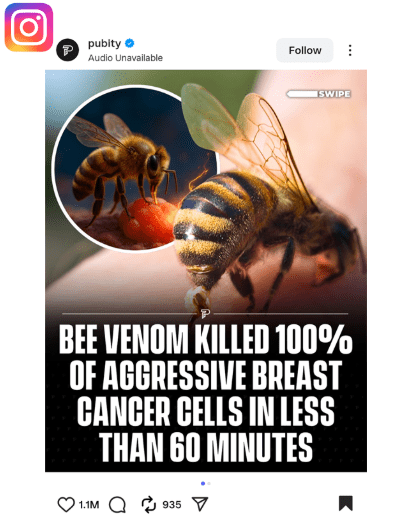
Wow! Amazing! Bee venom killed ALL breast cancer cells in under an hour! What a miracle cure! Why aren’t we hearing about this??? Does the government want to hide it just to keep us sick??
This is a compelling hook! In order to understand why this isn’t currently curing all of the breast cancer in the world, students need to understand more about how cancer works in the first place.
Aside from the compelling hook with social media, I interweave several posts with my typical lecture material and use these posts as active learning opportunities with my students! There are several objectives I have to guide what I incorporate:
- Data interpretation and graph literacy
- Students work through elements of complex figures
- Students identify and explain what works/doesn’t work in a figure
- Students draw out a new, revised version of a figure
- Evaluate claims centered around content knowledge from class
- Students pick apart accurate/inaccurate claims from a media post
- Students identify bias/neutrality in the post
- Couple iClicker questions to gauge understanding of content
- Assess novel content claims using evaluation skills learned in class
- Students find the original source cited (or not) in a media post
- Students work in groups to read parts of a primary research article
- Students reflect on how the post/research makes them feel
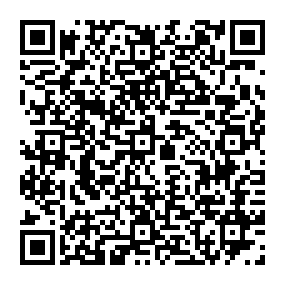
If you’d like some specific examples of how this plays out in this class, I’ve included a link to a workshop I lead at the Teaching 4 Learning conference at MSU Denver in Spring 2026 on this topic. In these slides, I also go over how to find useful pieces of media and strategies I use to sift through the massive ocean of content on social media. The QR code is included down below!
A few final tips and strategies that I’ve found useful:
- Interweaving social media content as active learning points within lecture works better than having a defined “lecture time” and “media time”
- Giving students a few minutes to work individually on questions before checking in with a partner dramatically increases engagement
- Avoid back-to-back media examples, unless they’re very quick analyses (e.g. graph interpretation). The more extensive the video or media, the more lecture break they need

